[Note: I'm hitting crunch time for finishing my semester papers, so I don't have time to write anything new. And unfortunately, all my papers are too obscure (not to mention unfinished) to post. So, I dug up a short paper I wrote 6 years ago at ACU to reproduce, unedited. I hope y'all will indulge me.]
Jars of Clay
Abilene Christian University
BIBM 391, Intro to Ministry
Profs. Robert Oglesby, Jeanene Reese
By Scott Haile
March 1, 2000
Of all biblical virtues, humility by its very nature eludes me more completely than any other. I can work on compassion and kindness and sincerity and self-control and even patience, but humility times its exits to the moments when I most succeed in otherwise imitating Christ. As the saying goes, once you realize you’re humble, you aren’t humble anymore. Dealing with that reality forces me to admit that too much of my effort has been aimed at fulfilling duty, following rules and performing works. By such means I can manage to be a pretty good person most of the time and treat others well enough that we can all overlook most of my faults. Meanwhile I fail to do the only thing that can really bring about humility--not working hard or studying my Bible, but falling prostrate before God.
Paul’s metaphor of cheap clay jars holding a valuable treasure describes this humility as it applies to his ministry, in sharp contrast to the attitudes of those around him. In 2 Corinthians 4:6 Paul tells of the glorious light God has put in his heart that is the gospel of Christ. But in verse 7 (NIV) he says, “But we have this treasure in jars of clay to show that this all-surpassing power is from God and not from us.” Though rabbis already taught a similar message of humility for ministry, this verse contradicted the views of many religious leaders at the time as it does the natural instincts of many of us today. Surely God has given us power so that we will use it, right? Surely a God who came to seek and save what was lost wants us to make his religion appealing to all those lost people so they can be saved?
Being raised in the church, I find Paul’s message here fairly easy to accept, and even preach to others. But figuring out where it works into my life and then actually following through present a greater challenge. Consequently, I need to keep the metaphor of the jars of clay in front of me at all times so that it will guide and shape my ministry--as indeed a potter shapes a clay pot--and keep my focus where it belongs, which is on the cross of Christ. The metaphor itself is simple, and trying to find dozens of points of connection between clay jars and Christian ministry would waste both my time and that of the reader. But the impact of that simple image on Christian ministry is incredibly profound, and that is where I will focus discussion.
First, the prevailing Christian attitude of the day apparently recognized power and prestige as signs of God’s favor. The people Paul was opposing were pretty impressive to young Christians, leading him to rather sarcastically refer to them as “super-apostles” (2 Cor 11:5). They were superior speakers (11:6) and tried to make themselves look good before men (10:12).
Jars of clay, on the other hand, are not impressive or powerful; some have referred to them as the “Tupperware” of ancient Greece--cheap, common, useful and disposable. But Paul says that God’s power is held in these vessels so that the power is indeed from Him and not from man. Savage notes two paradoxes in the metaphor: a valuable treasure is contained in a cheap vessel, and the incredible power of God is shown through a fragile vessel (165). The NIV translates the verse “to show that this...power is from God...” but the Greek text has a subjunctive “be” verb which more literally means “so that this...power might be from God...” (Savage 166) The point is that our weakness and fragility do not merely show the world that the power is from God (though it does do that) but is actually prerequisite for that power to work in us in the first place. “In other words,” Savage writes, “where there is pride and arrogance there cannot, by definition, be divine power.” (167)
OK, I’ve covered my academic bases. Now I’ll deal with why the metaphor is important to me in my ministry. First of all, my general inadequacy as a person scares me. Even if my own ability were extraordinary by worldly standards, the idea of trying to win souls from Satan by my own power would be enough to send me running. If I try to show how strong I am, I know he has the ability to knock me flat on my back. The simple fact that I have no supernatural powers at my disposal, and he does, assures me of my imminent defeat if I face him alone.
In contrast, seeing myself as a jar of clay to be filled with God’s power and broken if necessary helps conform me to the example of Christ. Following in Jesus’ steps (1 Peter 2:21) has to be my foundational theology, as it was Paul’s: “I want to know Christ and the power of his resurrection and the fellowship of sharing in his sufferings, becoming like him in his death, and so, somehow, to attain to the resurrection from the dead.” (Phil 3:10-11) Paul wants to become like Christ in his death so he can become like him in his resurrection. I think this so-called theology of the cross is the most important part of Christian ministry because it sums up who we are. I love what Daniel Von Allmen said in one of the articles I read, that “mission is a way of discipleship; mission is following Christ on his way through suffering to death and only then to resurrection” (265). According to Fred Craddock’s Preaching, the form of a sermon should mirror its content, and that applies to ministry as well. If the content of my ministry, what I want to tell people, is Jesus’ emptying of himself, then I need to likewise empty myself in my ministry so they can learn what I teach by how I live.
The clay jars metaphor also has a great practical strength, namely that it works. First, as I noted above, Paul seems to suggest that God only works through weakness. If this is the case, then living as jars of clay is not just preferable but necessary to Christian ministry, at least if God is to be involved in any active kind of way. Second, Allen says that our own weakness, or “the fragility of the clay pots” can witness to the world concerning the power of God (287). Again, how we teach can convert people as effectively as what we teach.
This metaphor can cause problems if someone interprets it in an unhealthy way. First, a person’s excessive focus on his own weakness and inability could lead him to the conclusion that he cannot do anything for God. Consequently, he probably won’t do anything for God but instead will walk around in fear of making a mistake and awaiting a voice from heaven to instruct him on exactly what he needs to do. The other major pitfall which I foresee brings me back to where I started, to the difficulty of learning humility. The easiest thing in the world for me to do, once I find myself working by God’s power rather than mine, is to look down on all those around me whom I perceive work by their own strength. At that point, my humility has obviously yielded to spiritual arrogance.
I don’t think humility can be taught by or deliberately learned by a human. There isn’t a person alive whom I could not find fault with if I looked, and that always allows me a loophole, it always allows me to write a person off if I don’t like what he says. God reserves the right to humble us when we need it, because like Job we can’t really answer him at all when it come right down to it. This really convicts me as I consider my call to ministry. If God calls me to do his work, I know he will give me the preparation I need, and so I trust that he will teach me humility in light of his holiness. Before sending Paul, God knocked him on his back so that he would serve in holy reverence. But if I decide for myself to go into ministry for him, I don’t know that I can count on that preparation. In the meantime I need to seek God so that I can learn who he is and wait for the day--or decade--when he confronts me and shows me what I’m made of.
Bibliography
Allen, Ronald J. “Between Text and Sermon: 2 Corinthians 4:7-18.” Interpretation 52 (1998): 286-289.
Barnett, Paul. The Message of 2 Corinthians. The Bible Speaks Today. Ed. John R. Stott. Downers Grove: InterVarsity Press, 1988. 86-87.
Craddock, Fred B. Preaching. Nashville: Abingdon Press, 1985.
Kistemaker, Simon J. II Corinthians. New Testament Commentary. Grand Rapids, Michigan: Baker Book House Co, 1997. 146-147.
Savage, Timothy B. Power through weakness: Paul’s understanding of the Christian ministry in 2 Corinthians. Paradise Valley, Arizona: Cambridge University Press, 1996. 164-169.
Von Allmen, Daniel. “The Treasure in Clay Pots.” International Review of Mission 77 (1988): 265-271.
Saturday, November 25, 2006


Friday, September 22, 2006
Fall Work Camp
At least 850 elderly or disabled residents in or around Chalmette, LA still need their houses gutted, so here's my bid to encourage folks to volunteer. They're pushing for people to come during one of four "work camp" times:
October 13–23
November 17–27
December 8–18
December 27 –– January 8
The work is difficult but doable and necessary. You can go work for a day or two, or you can stay for a full ten days. I recommend working from late one week through early the next, since they don't work on Sundays and it'll give you a break in the middle of your work. Housing is free, and they provide your food for $10 each day.
Hilltop Rescue & Relief is run out the second floor of an elementary school whose first floor was ruined by the flooding and whose students no longer need the classroom space in this decimated town. They have months and months of experience leading groups, and they run their program efficiently: they help you do what you can in the limited time you have to volunteer.
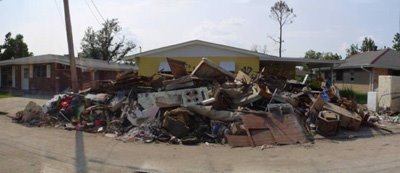
The pile of trash pictured above is what we pulled out of the yellow house behind it in a day and a half of work.
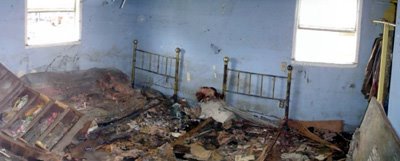
Below is a photo of a room that I worked on for most of a day, taken after I spent two hours throwing out wheelbarrow- and arm-loads of crumbled dry wall which had fallen from the ceiling, along with mattresses, closet doors, and countless clumps of nondescript matter which used to be the contents of an elderly couple's master bedroom. When I first arrived, I had to climb over stuff to get into the room.
The finished house is gratifying, and it's an enormous burden off the shoulders of the homeowner:

This is a rare opportunity to do work that solves an actual problem for people who can't do for themselves, working for an organization that won't waste your time and efforts. For details, visit the Hilltop website. If you know people who are capable of this kind of work, please consider referring them either to this post or to the Hilltop web site.
Wednesday, August 30, 2006
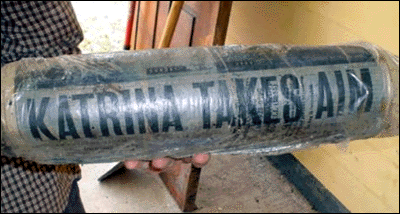
Last week I went with a group of teens and adults from two NJ churches to muck houses for four days in Chalmette, LA.
I'm trying to think how to describe my visit.
I'll try this: imagine driving through the town you live in, and seeing all its restaurants and shops. Then imagine that nearly all of them are empty. Windows are busted out, signs are crumbling, and nailed to every telephone pole are a dozen advertisements for house-gutting or mold treatment or remodeling. Walgreens and Home Depot run a steady trade, but everything else is shut down, waiting for the populace to return before attempting to open again for business. There's a rumor that McDonald's and Wendy's will reopen this fall.
On residential roads, a few people live in trailers on their front lawns, while the rest of the houses are abandoned or for sale "as is." Some haven't been touched since the storm. A random 20-foot boat sits where it came to rest on someone's front lawn. One guy has spray-painted in large letters on his garage door, "You loot, I shoot." Presumably this is left over from right after the storm, but if not for the fact that everything in all these houses was ruined, you might wonder if he's still in there with his 20-guage.
It's been an entire year now, and that's what it still looks like.
It may sound odd that houses remain untouched after an entire year, but life sometimes gets complicated. Having even a small house gutted by a contractor (leaving only the frame, walls, roof, and plumbing) might cost $2000, and many of those still in need of help are elderly and working-class. Both of the families we worked for had multiple homes belonging to multiple generations that were destroyed in the storm. I don't even know how poorer families are managing.
Even after the homes are mucked out, they still have to be treated for mold. And then an inspector will visit and tell each family whether their house may be restored or whether they must demolish completely and rebuild.
Feel free to comment with stories or facts about the storm; I'm sure there are plenty in the news this week for the anniversary. I'll post more on this soon.
Subscribe to:
Posts (Atom)